



The Monday After • Nov 3, 2025
Do We Undersell Romans 14 Call to Unity?
 Darren Carlson
Romans 14 asks a searching question of every local church: what do we do with disputable matters? Some truths and practices are non-negotiable; others are genuinely secondary. The gospel—not a fragile peace—is ultimate. Because Jesus is Lord, we must learn to hold convictions firmly while welcoming one another gladly. That can be uncomfortable.
The situation in Rome revolved around food and days—questions that might seem small to us but were immense in the first century: how should Jewish Christians relate to the Law now that Christ has come? Paul's answer is striking. Jesus is Lord of the Sabbath-keeping, kosher-keeping believer and of the market-shopping, bacon-eating believer. If the risen Christ has received us, we must receive each other (Rom 14:3–4; 15:7). Paul does not command either group to abandon its practice. He commands both groups to stop judging and setting stumbling blocks for one another (14:3–4, 10, 13). The heart of the chapter is mutual acceptance rooted in the lordship of Christ: we belong to the same Master and live our lives before the same Judge (14:7–9).
Verse 14 is crazy, and I think about what Paul is saying often:
I am convinced, being fully persuaded in the Lord Jesus, that nothing is unclean in itself. But if anyone regards something as unclean, then for that person it is unclean.
How can Paul, who is writing God-breathed words, tell people to do the opposite of what he is convinced is right? Paul is personally persuaded—he is "team bacon" and "team Sunday," —yet he instructs believers who disagree to follow their conscience before the Lord. That raises a searching question for us: where could I say, "I'm fully persuaded in the Lord Jesus," and still add, "and you may do the opposite unto the Lord," while embracing the other as a brother or sister?
This is not quietism masquerading as charity. Paul does not say, "Have your truth and I'll have mine." He says that each Christian should be fully convinced in his or her own mind (14:5). Minor matters do not call for weak convictions; they call for humble, biblically formed convictions. The antidote to judgmentalism is not silence; it is charity with clarity. Churches where disagreement is treated as disloyalty can never practice Romans 14. Paul neither flattens doctrine nor splits the congregation. These were visible behaviors bound up with profound theological questions—the relationship of the Old Testament Law to the gospel—yet he refuses to resolve the debate by fiat. He reframes it: "The one who eats, eats in honor of the Lord... while the one who abstains, abstains in honor of the Lord" (14:6). Christ-honoring motives, not identical practices, are the measure of faithfulness in secondary matters.
I think we undersell Romans 14 in two ways.
First, we keep it "safe," applying it only to questions like music styles, dress, tattoos, or whether to trick-or-treat. Those may fit, but Paul's logic reaches further—into practices that sincere Christians tie to Scripture where faithful readers still differ.
Second, we export unity while avoiding it locally. Or we apply it to parachurch work, but not a local church. We say, "I'm one with all Christians everywhere," yet refuse to worship in the same congregation with those who land differently on non-essentials. Paul's counsel is the opposite: work this out in one body. Pursue "what makes for peace and for mutual upbuilding" (14:19). Welcome one another as Christ has welcomed you (15:7).
What might maturity look like in this terrain? It looks like deep convictions formed by Scripture and prayer, open-handed humility that recognizes other believers, under the same Lord and with the same Bible, may land elsewhere, and a gospel-driven welcome that preserves table fellowship even when opinions diverge.
The Romans 14 question is not, "Can I win the debate?" but, "Can I articulate my biblical case, honor someone who lands elsewhere 'unto the Lord,' and still preserve the Lord's table and the bonds of affection?"
It is important to note that Paul does not force them to practice something that violates their conscience. He is asking them to be ok with others practicing something that violates their conscience. Romans 14 does not call us to paper over differences or to multiply churches for every scruple. Unity isn't ultimate; Jesus is. Precisely because he is, we "make every effort to keep the unity of the Spirit in the bond of peace" (Eph 4:3)—not by surrendering conviction, and certainly not by wounding a brother or sister for whom Christ died (Rom 14:15), but by receiving one another as we ourselves have been received in Christ, to the glory of God (15:7).
Take the test: What are you fully convinced in the Lord of, and yet still can bless another Christian to practice something that contradicts your theological conviction? Unity is easy when people bend toward you. How will you bend toward your brothers and sisters?

Recently, in a relatively closed country in Central Asia, a short-term missions team was traveling by train. Before boarding, a short-term team member tried to watch the JESUS film on her tablet, but it kept glitching—freezing and shutting down—so she slipped it back into her bag and found her seat. She dozed off.
A little while later, an elderly man gently woke her. "Daughter, something is speaking in your bag," he said. "Take it out! It sounds like it's saying something good." The tablet had started playing again—loud enough for nearby passengers to hear.
She explained it was a film about Jesus Christ, took out the tablet, and began showing the movie to the carriage. For the rest of the journey, she shared more videos from the Jesus Film Project app. During the ride, a 71-year-old grandmother repented and received Jesus as her Lord and Savior right there on the train.
The team member gave her the address of a local church. Not only did she come the following Sunday—she brought her daughter, her son, and her daughter-in-law. She now attends regularly and is eager to be baptized.

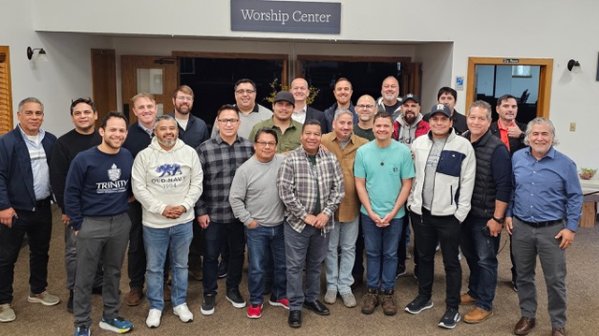
Instead of a resource this week, I'm just going to ask you to pray. The Training Leaders International board is gathering in Bozeman, Montana, for its semiannual meeting. There is much to discuss—and much to rejoice over. This year, TLI celebrated 500+ graduates across our training programs worldwide, an all-time high.
In addition, Redeemer Church in Bozeman is hosting a training for EFCA Latino pastors (pictured above) this coming week. We have been meeting together for two years to help refine the preaching skills of these dear brothers.
Thank you for praying!
Thanks for checking in.
Sign up here to receive Darren Carlson's The Monday After email. This weekly newsletter is designed to encourage your faith and share inspiring stories of what God is doing around the world. Each edition features a short devotional, a story that will give you a glimpse of His work in unexpected places, and a resource you might find helpful.
4.13.26Guard Rails on Calling Someone Divisive
Warn a divisive person once, and then warn them a second time. After that, have nothing to do with them. You may be sure that such people are warped and sinful; they are self-condemned. If you know me, you know I spend a lot of time thinking about what unity actually […]
4.6.26What was Judas Thinking?
There is something uniquely unsettling about Judas's betrayal. This was not a stranger in the crowd. This was a man who had walked with Jesus for three years—shared meals, witnessed miracles, and even performed them. When he finally made his move, he did it with a kiss. "The one I will […]
3.30.26Influencers In the Flesh
Do you know the people who have influenced you most? Stop and think about it honestly. If you made a list, would the names on it belong to people who actually know you—who know your name, your failures, your kitchen, your kids? For most of us, the honest answer is uncomfortable. […]
3.16.26The Death of Gentle Parenting
Maybe those strict parents weren't so bad after all. For the past decade, a particular parenting mood has seeped into the air: be less authoritative, more collaborative. Give kids space. Negotiate everything. Process every emotion endlessly. Never "rupture connection." Therapists and self-proclaimed experts — thirty-year-old moms with one child and […]


