



The Monday After • Mar 16, 2026
The Death of Gentle Parenting
 Darren Carlson
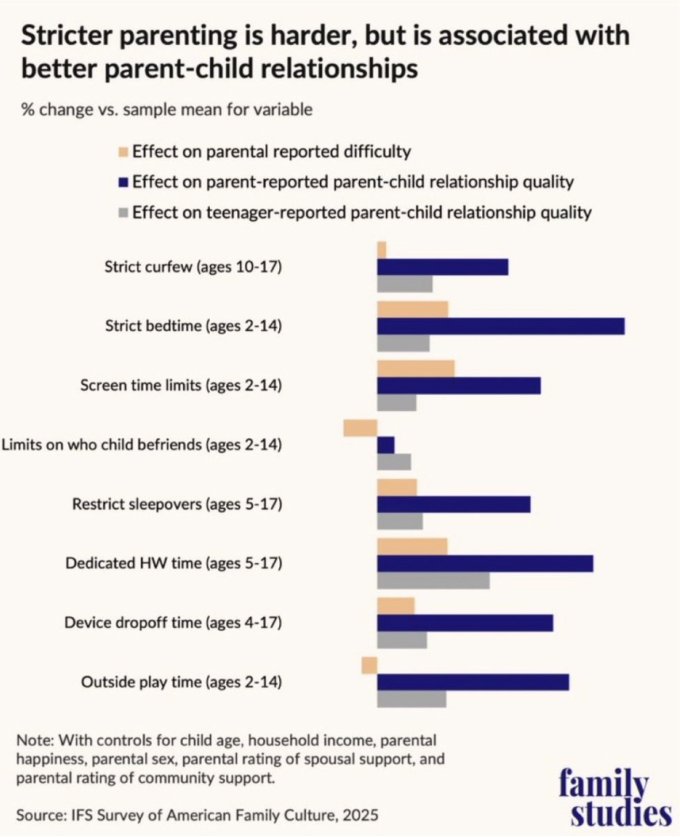
Maybe those strict parents weren't so bad after all.
For the past decade, a particular parenting mood has seeped into the air: be less authoritative, more collaborative. Give kids space. Negotiate everything. Process every emotion endlessly. Never "rupture connection." Therapists and self-proclaimed experts — thirty-year-old moms with one child and an unlimited budget — took to Instagram to help young, stressed-out parents. The Gentle Parenting movement has thoroughly captured millennial and Gen Z parents.
And of course, every generation swears it won't repeat the "mistakes" it saw growing up. That impulse can be humble — I want to do better — or proud — I'll pave my own road and ignore the wisdom that came before me. It is very Western of us to throw off family and tradition to chart our own path. But we now have evidence that gentle parenting is not as great as some had hoped.
According to teenagers themselves, homes with curfews, set bedtimes, screen limits, device drop-off times, and dedicated homework blocks produce higher relationship quality — not lower. Children in structured homes report stronger bonds with their parents. Even the rules that seem most likely to create distance actually build closeness.
The data points to something counterintuitive: when parents impose structure, the relationship improves. And when parents just let their kids do what they want, the relationship is harmed.
For the past decade, many parents have been sold a version of parenting that collapsed into boundary avoidance — endless negotiation, emotional processing without enforcement, and a terror of saying "no" for fear of rupturing connection. But connection without authority is not connection. It is dependency.
The Bible speaks plainly about the relationship between love, discipline, and formation — and it does so not as a concession to harshness, but as a window into the character of God himself.
"Whoever spares the rod hates their children, but the one who loves their children is careful to discipline them." — Proverbs 13:24
Withholding correction is not kindness — it is a failure of love. But notice the logic beneath the surface: the parent who disciplines is the one described as caring. Discipline, in this frame, is not reactive anger — it is attentive love. The parent who cannot bear their child's momentary frustration may, in the end, spare themselves discomfort while costing their child something far more significant.
It may be that the worst versions of gentle parenting are not really about the child at all. Everyone wants their child to flourish — that instinct is good and universal. But boundary avoidance is often less about the child's success and more about the parent's discomfort. The parent who cannot hold a limit is frequently the parent who cannot tolerate the sight of their child's frustration. That is not sensitivity to the child. It is, in a quiet way, self-absorption — the parent's need for peace and approval dressed up as attentiveness. The child's momentary displeasure becomes unbearable not because it signals something wrong with the child, but because it signals something the parent cannot sit with in themselves.
"A rod and a reprimand impart wisdom, but a child left undisciplined disgraces its mother." — Proverbs 29:15
Notice that the Bible does not frame structure as harshness. It frames the absence of structure as neglect. A child left to self-govern — without the wisdom, experience, or fully developed judgment to do so — is not being honored. They are being abandoned to themselves. Proverbs assumes that wisdom is not native to the human heart; it must be instilled. Children are not born knowing how to order their desires, manage their impulses, or weigh long-term consequences. That formation is precisely what parents are called to provide.
A bedtime says: your brain matters more than your entertainment. A screen limit says: your developing mind needs a guardian, and I will be that guardian. A curfew says: your safety matters more to me than avoiding your disappointment.
The winning formula is not tyranny. It is what researchers now call high warmth plus high structure — and it is what the Bible has called faithful parenting for three thousand years. Warmth without structure is abdication dressed in empathy. They need adults who can absorb their anger without moving the boundary — someone whose judgment they can lean into while their own is still forming.
If you have been shaped by the gentle parenting movement, it is worth asking whether your love has quietly slipped into boundary avoidance. Is there a rule or limit in your home that you've softened or removed because of your child's pushback? What would it take to hold that line — with warmth?

Four years ago, a young man in Pennsylvania joined an atheist club whose members decided to make a statement. They went to every used bookstore they could find, bought up old Bibles, and burned them. He participated — but kept one copy for himself, thinking he would read it and be better equipped to argue against it.
He started in Genesis. He was surprised. The Bible was not what he had assumed. So he kept reading, and then he began memorizing it — not to believe it, but to use it against Christians.
Then one Sunday, he walked into our church, brought by his Lutheran friend, who had never set foot in an evangelical church. Afterward, the two of them said the same thing: they had never experienced anything like it. For the atheist, it was the first time he had ever been inside a church in his life. It was, by his own account, overwhelming.
The following Tuesday morning, at the Western Cafe here in Bozeman, he became a Christian.
He told me that his parents are both agnostics, but his grandfather had heard the gospel at twenty and didn't come to faith until he was seventy. And even so — he could tell the difference. He could see it in his grandfather, and he could see it in the Christians around him. "They were just different," he said. "They were kind."
And then the story gets stranger. He was heading back to Harrisburg,
Pennsylvania for the summer. And who lives in Harrisburg? The man I thought would plant this church before I ever applied. The man who discipled Amy and me. The man whose own son is an atheist. The man I would trust to disciple someone more than anyone else I know.

This will be out of right field, but I have been reading East of Eden. It's dark and beautiful. It's also a commitment. I think it's worth it. My favorite character is Sam Hamilton. He may be yours, too.

Thanks for checking in.
Sign up here to receive Darren Carlson's The Monday After email. This weekly newsletter is designed to encourage your faith and share inspiring stories of what God is doing around the world. Each edition features a short devotional, a story that will give you a glimpse of His work in unexpected places, and a resource you might find helpful.
4.13.26Guard Rails on Calling Someone Divisive
Warn a divisive person once, and then warn them a second time. After that, have nothing to do with them. You may be sure that such people are warped and sinful; they are self-condemned. If you know me, you know I spend a lot of time thinking about what unity actually […]
4.6.26What was Judas Thinking?
There is something uniquely unsettling about Judas's betrayal. This was not a stranger in the crowd. This was a man who had walked with Jesus for three years—shared meals, witnessed miracles, and even performed them. When he finally made his move, he did it with a kiss. "The one I will […]
3.30.26Influencers In the Flesh
Do you know the people who have influenced you most? Stop and think about it honestly. If you made a list, would the names on it belong to people who actually know you—who know your name, your failures, your kitchen, your kids? For most of us, the honest answer is uncomfortable. […]
3.9.26Screen Time
Can you find any research that tells us screens are good for us? Sort of—but it depends on what we mean by "screens" and how they are used. Screens can connect grandparents to grandkids over video chat, provide access to excellent teaching, help children with disabilities communicate, and even allow teens […]


